
Prophet to Pioneer
A story about spending eight billion tokens on a worst-in-class stats app for youth soccer.
September 30, 2026 · Will Smith
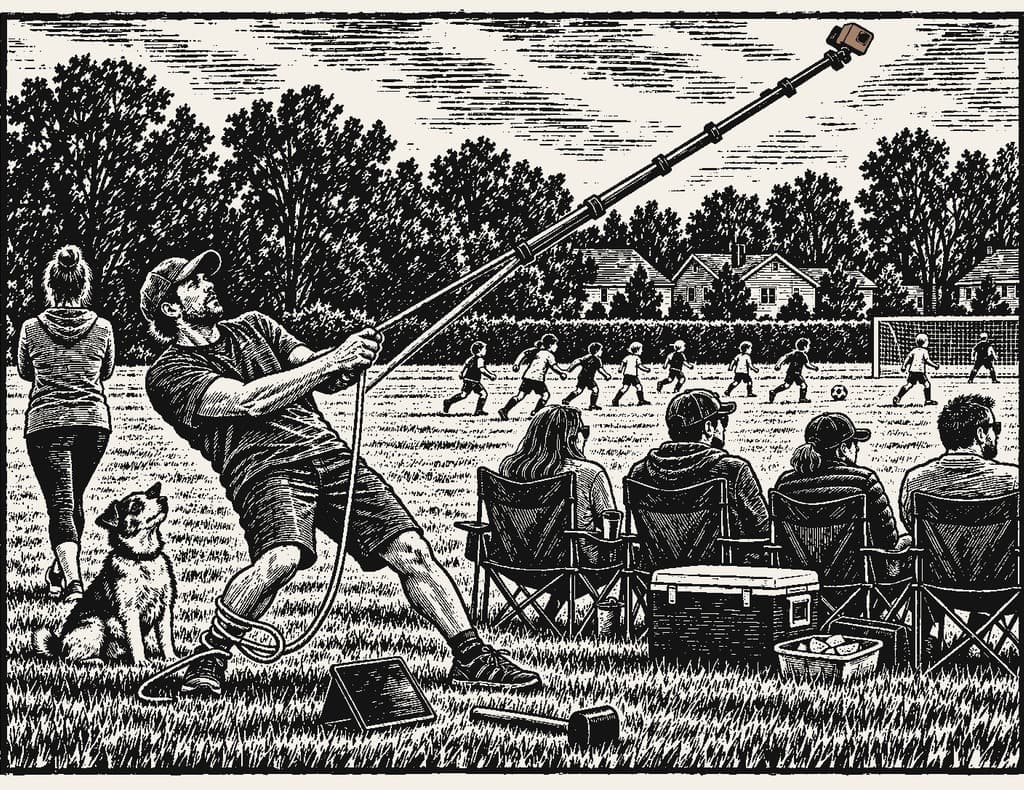
A few weeks ago I asked my wife to set up a camera on a fourteen-foot pole at our daughter's soccer game, and she refused. Not because it was hard. If you've stood on the sideline at a ten-year-olds' game you know the rules, even though nobody says them. You don't coach from the fence, and you don't do anything that suggests you think the game matters more than it does, because every parent there is quietly worried about being that parent. A fourteen-foot pole with a camera on top says all of that at once. It makes you look like a goober, and she wasn't willing to be that person in public. She was right, and she decided it in about a second.
There was a rule like that in the way of what I was building too, one I'd been obeying for a year without knowing it.
I set it up myself the next weekend. The pole is there because I built an app that does FIFA-level statistics and highlight reels for a team of ten-year-olds. I knew it was a stupid project when I started, and I knew it was a pretty involved piece of software, which was worse, because it meant the thing between me and the finish was quite a bit of my own time. What got me over that was deciding that if it worked at all, it would change my understanding of where the technology is, and that seemed worth the time in a way the highlights didn't.
Before I started, I'd spent a lot of time around the people at the center of the token-maxing story, the crowd StrongDM was describing when they said a thousand dollars of tokens a day per engineer was the floor. I wasn't a skeptic. These were exactly the kinds of people I invest in, and I spent that spring trying to understand how they worked.
James Cham told me about StrongDM first. Then I met Justin McCarthy, a co-founder, and he talked about himself as purely an executive function, like Bezos: get an update, ask it to go deeper, then on to the next thing. They'd run their engineers through the change, and some came out the other side and some didn't.
Then a friend who'd taken his own company through the conversion told me the hard part was the people, and that it was like taking the best baristas in the valley and telling them to use a latte machine. What I took from that was that I am not an amazing barista.
So I took them as prophets, people describing something coming that they'd already seen. As an investor I believed all of it. As a builder I was waiting for it to reach me, and I didn't think it was here yet.
What was actually in the way was that I'd been frugal with tokens without knowing it. I don't think about subscriptions or usage bills when I'm using something. It's just the cost of doing business, and I was vibe-coding my ass off the whole time. But the scale of what I built was always a little smaller than what I wanted, and I didn't notice I was the one scoping it down.
Would I have spent eight billion tokens to build an app that might not work so I could see a couple of highlights from my daughter's soccer game? That's tens of thousands of dollars on a frontier model, and it never even got as far as a decision. The fun little weird toys I wanted to build were never going to be worth that, so I never seriously considered them.
StrongDM had written this down. Generations of engineers, they said, may have wanted a full in-memory replica of their CRM to test against, but self-censored the proposal. They didn't even bring it to their manager, because they knew the answer would be no. I read right past it.
The app ran on LunaRoute, one of our portfolio companies, where I've been in the alpha. Eran Sandler is careful to say LunaRoute doesn't sell cheaper tokens. What you buy is a fixed amount of capacity, with a scheduler underneath that knows the difference between a person waiting and an agent waiting. The person gets served fast, and the agent's work gets held back and run when there's room, which an agent doesn't mind. So the meter is still there. It just counts how much you can run at once instead of tokens, and that turned out to be the unit that matters, because once you've paid for the capacity the silly ideas don't have to make a case anymore. You just try them.
The closest thing I can compare it to is the winter AOL went flat-rate, when I was a kid. We'd had the internet before that, by the hour, and you got on, did your thing, and got off. After that you stayed on and wandered.
The app's not done. In mid-September the vision model produced a contact sheet of forty-three crops of players it thought were on my daughter's team, the agent building it asked me to pick her out, and I typed "none," because she wasn't in any of them.
A few days later the agent's own test preferred one tracker setting. I watched the reel and found ten errors in it, and it conceded with the right reason: the test set was built from moments I'd already labeled, so it flattered the tracker. Its words were "your check wins." In both cases the problem was the vision model underneath the LLM. The only way I found it was by standing there knowing what my kid looks like.
What I built is not as polished as Veo or Trace, the products parents pay for, and plenty of teams in club soccer have one on the sideline. If I showed mine to the LunaRoute alpha testers it would be pretty embarrassing. It's also so far beyond my own bar for myself that I'm still a little surprised.
What made me feel better was parents who use the real products telling me their kids' goals don't get attributed to them either. The big products are definitely better than mine, and they fall short in the same places, because those places are hard. It took me about a month to reach the same wall they're stuck at.
The other thing I've been doing, which is less of a toy, is pointing models at problems I would never have thought to point them at while I was paying by the attempt. I've been building a personal event spine, mostly to be the guinea pig for another company we've backed before asking anyone else to be.
A model sorted out who's who across the thirty thousand or so people in my own CRM, pulled from seven different systems. I ran that four times in three days because I could, and it still isn't good enough that I'd let it merge two people without looking.
The prophets I'd filed away had managed teams of geniuses before and gotten what they wanted out of them. I'd only ever done that with someone like them standing between me and the engineers. Now the model is that layer, and what's left for me is knowing when what it built is wrong.
They weren't braver than me. They had better reasons than I did to believe it would pay off, and they were willing to look stupid first.
I spent a lot of time on the soccer app, and I'm not sure I'd spend it again on this. I'm certain I'll spend it again on something, and that's the part that changed.
The machine didn't build it for me. When the bill stopped being the thing in the way, my time was. Behind that was the same rule my wife saw on the sideline in about a second: don't look ridiculous for something that isn't supposed to matter.
A prophet talks about a world they've seen coming. A pioneer is already living there, which means it exists and you can go too.
LunaRoute opened to the public today. What you get is fixed-price capacity on open-weight models, with zero data retention by default, and it sits behind Claude Code, Codex or Pi without changing how you work. Eran's launch post makes the general version of the argument I've made here with a soccer app, and he makes it better.
Congratulations to Eran, Gur Brosh and the LunaRoute team, and thank you for the lane. I'd suggest everyone start with the stupid project.